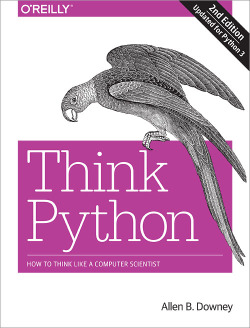
Think Python
How to Think Like a Computer Scientist
- License
- Creative Commons Attribution-NonCommercial 3.0 Unported
- Source
- Green Tea Press
Description
A concise introduction to Python and computer-science thinking, built around problem decomposition. Covers variables, functions, conditionals, recursion, iteration, strings, lists, dictionaries, and a light introduction to classes and objects.
Book information
- Language
- English
- Category
- Python
- Level
- Beginner
- Pages
- 290
- Published
- 2015
- Format
- License
- Creative Commons Attribution-NonCommercial 3.0 Unported
- Source
- Green Tea Press
Topics
License
Creative Commons — Creative Commons Attribution-NonCommercial 3.0 Unported (license text ↗)
This resource is listed because its license permits redistribution.
Same license Downey uses for his other Green Tea Press books.
Related books
View all →
How to Think Like a Computer Scientist: C++ Version
Allen B. Downey
A gentle introduction to programming and computer-science thinking using C++. Builds from variables, expressions, and functions up to recursion, classes, vectors, and larger programs, emphasising problem decomposition over syntax.
C++BeginnerCreative CommonsPDFC# Programming
Wikibooks contributors
A community-written introduction to C# and the .NET platform, covering language fundamentals, object-oriented programming, collections, exceptions, and the standard library. Continuously maintained on Wikibooks.
C#BeginnerCreative CommonsPDF · 1.4 MB
The C# Programming Yellow Book
Rob Miles
A friendly, first-principles introduction to programming using C#, used to teach first-year computer science students at the University of Hull. Covers variables, control flow, methods, objects, and building real programs, with a healthy sense of humour.
C#BeginnerAuthor PermissionPDF · 1.6 MB